
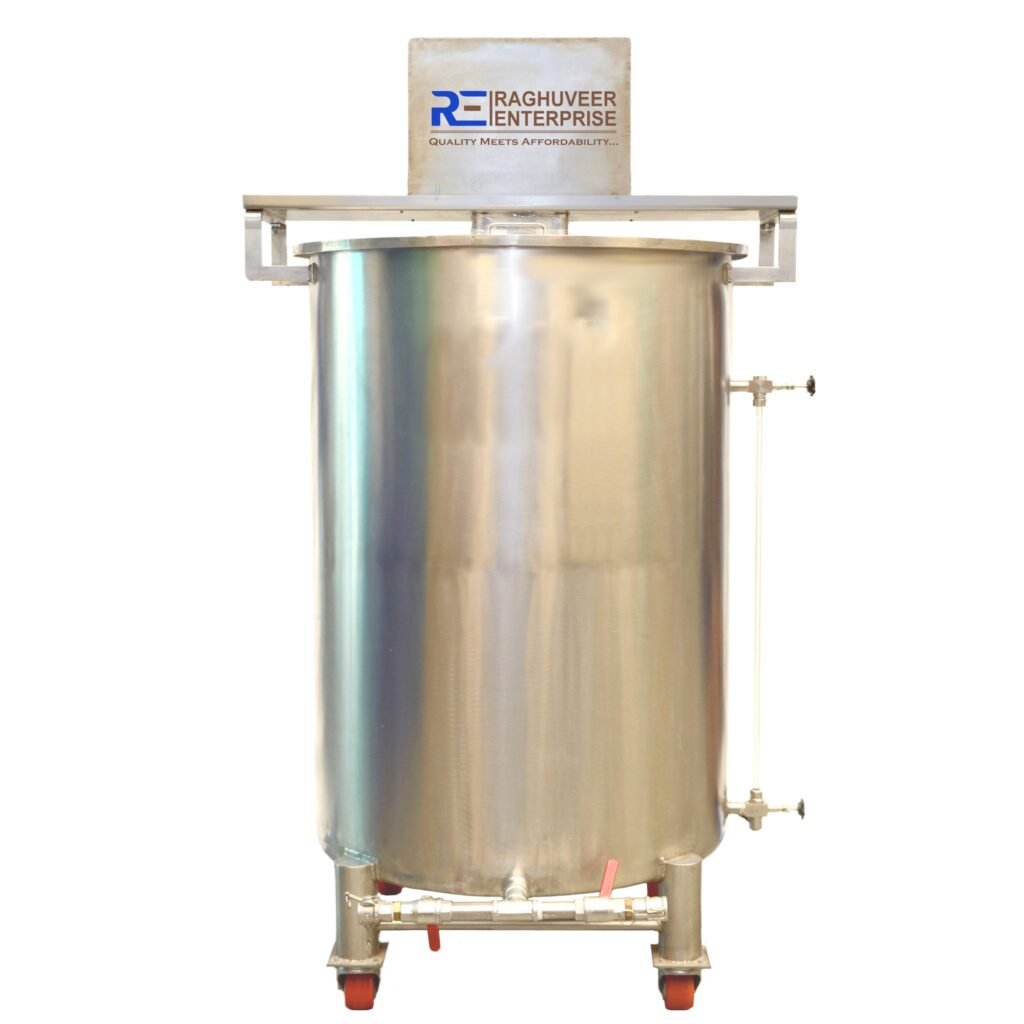
In the world of industrial processing, especially in sectors like food, pharmaceuticals, cosmetics, and chemicals, liquid mixing tanks play a pivotal role. They are the core equipment in operations where blending, homogenizing, dissolving, suspending, or heating liquids is essential to creating a consistent and high-quality final product.
Whether you’re making beverages, lotions, syrups, detergents, or chemical solutions, a liquid mixing tank ensures product uniformity, process repeatability, and efficient production.
In this article, we explore everything you need to know about liquid mixing tanks their structure, working principles, types, applications, benefits, and key considerations for choosing the right one.
What is a Liquid Mixing Tank?
A liquid mixing tank is a vessel designed to mix, agitate, blend, or store liquids and semi-liquids. It is equipped with one or more agitators or impellers, and may include features such as heating or cooling jackets, insulation, level indicators, and control systems to optimize the mixing process.
These tanks are used not only for blending multiple liquid ingredients but also for dispersing powders, dissolving solids, maintaining suspension, and ensuring temperature control where necessary.
How Does a Liquid Mixing Tank Work?
The working principle is relatively straightforward:
- Ingredients are fed into the tank manually or via automated dosing systems.
- The agitator starts rotating, creating turbulence and circulating the liquids inside the tank.
- If the process requires heating or cooling, the jacket circulates the temperature-controlled medium.
- Mixing continues for a predefined time until the desired uniformity or reaction is achieved.
- The final product is discharged through valves to the next stage of the process or packaging.
The agitator’s design, speed, and placement are critical for achieving the right flow patterns and mixing intensity.
Types of Liquid Mixing Tanks
1. Stainless Steel Mixing Tanks
- Widely used due to durability, hygiene, and corrosion resistance.
- Suitable for food, pharmaceutical, and cosmetic use.
2. Jacketed Mixing Tanks
- Feature a double-wall (jacket) for heating or cooling the liquid inside.
- Ideal for temperature-sensitive applications.
3. Agitated Mixing Tanks
- Equipped with mechanical agitators or impellers.
- Best for thorough blending, emulsifying, or suspending solids.
4. Vacuum Mixing Tanks
- Allow mixing under reduced pressure.
- Prevents air bubbles, ideal for cosmetics and creams.
5. Pressurized Mixing Vessels
- Used where high-pressure mixing or reactions are required.
- Common in chemical and pharmaceutical industries.
6. Plastic (HDPE/PP) Tanks
- Cost-effective, corrosion-resistant alternative for non-food or non-pharma use.
Whether you’re manufacturing sauces, sanitizers, syrups, or skincare products, a liquid mixing tank is an essential part of your processing setup. By ensuring consistent product quality, improving process speed, and maintaining hygiene, these tanks deliver high return on investment over time.
Investing in the right mixing tank not only boosts your operational efficiency but also supports product innovation and scalability.
Need Help Selecting the Right Liquid Mixing Tank?
At Raghuveer Enterprise , we specialize in custom-engineered liquid mixing tanks for various industries. From compact 100-liter units to large 10,000-liter tanks with advanced automation, we offer solutions tailored to your specific process requirements.
https://raghuveerenterprise.com/contact/Contact Us for expert advice, pricing, and equipment customization options.